




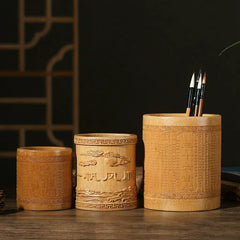


Chinese Bamboo Brush Pot, Hand-Carved Pen Holder & Makeup Brush Cup - calmlucky
Carved Bamboo Brush Pot A...
- $33.00
$41.50- $33.00
- Unit price
- per
Subtotal:
$33.00
Natural materials
No two pieces exactly alike
Free shipping over $59
30-day hassle-free returns


Carved Bamboo Brush Pot
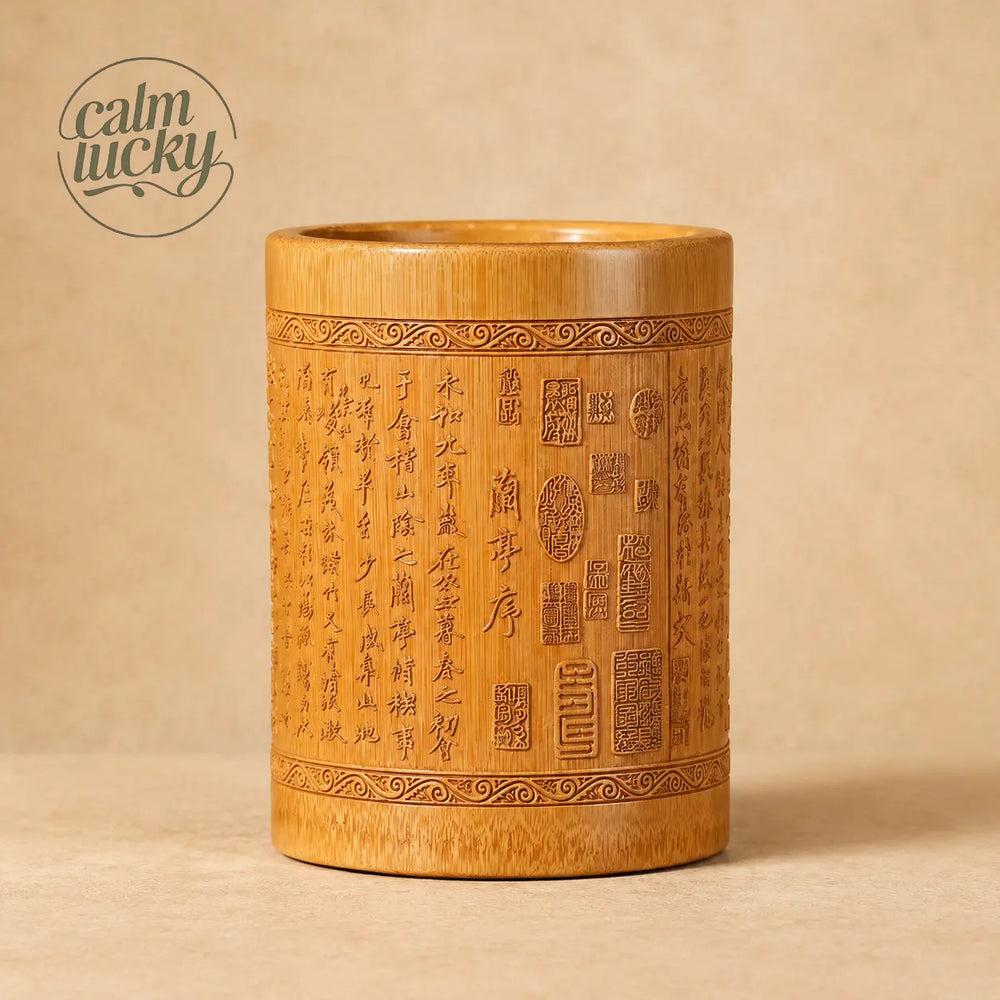
A carved bamboo brush pot is a cylinder cut from a single bamboo culm and carved around its full circumference, with calligraphy, figures or plants. In a Chinese study it held brushes. On a desk it holds pens, in a bathroom it holds makeup brushes, and beside a tea tray it holds the tools of gongfu tea. The form is not a modern invention: the Metropolitan Museum owns Ming dynasty bamboo brush pots carved in the 1600s, and the reason the shape has not changed is that a culm already is a vessel. Nobody has to build one. Somebody only has to cut it well.
Why it is cut from a culm, not built from boards
Most bamboo products are strips: flattened, glued, pressed into a board and cut. That is how you get a bamboo cutting board or a bamboo floor. A brush pot cannot be made that way, because the whole point is the continuous wall, one unbroken cylinder with the grain running vertically around it the way it grew.
So each one starts as a section of culm, selected for wall thickness and straightness. The bamboo used here is jin zhu, golden bamboo, chosen for two properties: it grows thick-walled relative to its diameter, and its skin takes a carved edge without tearing. A culm wide enough for the 14 cm base runs close to a centimetre of wall. You can feel that at the rim. It is not a shell.
The kiln does the work the weather used to
Fresh bamboo is roughly a third water by weight and it is full of starch. Both are problems. Water means the piece shrinks and moves as it dries, and starch is what borers eat. Traditionally, cut bamboo was stacked and left for a year or more to settle. The pieces here are heat-treated instead, held at temperature until the moisture and the starch are driven out. The side effect is the colour: the bamboo darkens from pale straw to a warm amber it would otherwise only reach after years of handling.
What heat treatment does not do is make bamboo immune to cracking. Nothing does. What it does is remove the two reasons a new piece cracks in its first year. After that the material moves with the seasons like any natural one, which is why the care instructions below are short and boring.
Carved, not printed
The text on these is cut. Not etched, not laser-burned, not printed. The difference shows at the edge. A laser burn leaves a brown halo around every stroke and a slightly rounded trough; a printed wrap leaves a seam where the pattern meets itself. A chisel cut has a crisp shoulder, and if you run a fingernail across the characters you feel a wall, not a dip.
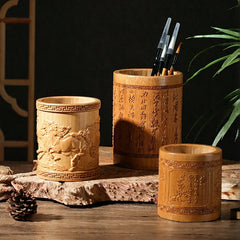
Two carving styles are offered. The relief pots carry shallow-cut calligraphy across the whole surface with a decorative band at the rim and base. The deep-carved pots cut further in: the design stands proud of the background by several millimetres, which is why a horse or a sail casts its own shadow when the light comes from the side.
Both are done by hand on a finished cylinder, and the carving happens last. A slip in the final hour is not repairable. You cannot fill a cut in bamboo and have it disappear. The piece goes in the scrap pile.
What the characters actually say
Seven designs, and every one is a real text or a real motif rather than decorative squiggles. This is the part most listings skip and the part buyers ask about.
- The Analects — the sayings of Confucius and his students, compiled around 400 BCE. The line carved in large characters on this one is xue er bu yan, hui ren bu juan: never tire of learning, never tire of teaching. It is the sentence a Chinese teacher recognises from the first page.
- Preface to the Orchid Pavilion — written by Wang Xizhi in 353 CE and generally called the most famous piece of calligraphy in the Chinese language. It runs 324 characters and describes a spring gathering of forty-one scholars beside a stream. The original no longer exists; what survives are copies, and every serious student of Chinese writing knows it by sight.
- Thirty-Six Stratagems — a collection of military stratagems rather than a single book, assembled over centuries and numbered one to thirty-six. They are still quoted in Chinese business writing. The most famous is the one about making noise in the east while attacking in the west.
- Four Gentlemen — plum blossom, orchid, bamboo and chrysanthemum. These four plants are the standard subject of Chinese ink painting, and each carries a season and a temperament: plum in winter, orchid in spring, bamboo in summer, chrysanthemum in autumn. Not a flower pattern — a set of four ideas.
- Smooth Sailing — a sailboat running before wind and cloud. The Chinese phrase is yi fan feng shun, one sail, favourable wind, and it is the one design here with an exact English equivalent. It is given to people starting something: a business, a voyage, a move.
- Horse & Success — a galloping horse, and the phrase ma dao cheng gong: the horse arrives, the success is done. The image comes from cavalry, where the side whose rider got there first had already won. It is the standard wish for a promotion or an exam.
- Qin Yuan Chun — the name of a ci metre, one of the fixed tune patterns Chinese poetry is written to. Several well-known poems use it. If you need a specific text, message us before ordering and we will tell you what is carved on the version in stock.
Three sizes, measured at the rim, the base and the height
Bamboo is not a machined tube, so these are approximate and the maker states them as such:
- Small — 8.5 cm rim, 10.5 cm base, 10.5 cm tall. Roughly a mug. Takes pens, pencils and makeup brushes.
- Deep-Carved — 9 cm rim, 11 cm base, 13 cm tall. Same footprint as the small, half again as tall. The deep carving needs the extra height to read.
- Large — 12 cm rim, 14 cm base, 16.5 cm tall. The one that takes a full set of calligraphy brushes, a kitchen’s worth of utensils, or a makeup collection without crowding.
All three flare slightly from rim to base, because that is how the culm grew. A pot narrower at the bottom than the top would have to be machined, and machined bamboo is a different product.
One cylinder, four jobs
It is sold as a brush pot and it works as one, but that is not why most people buy it.
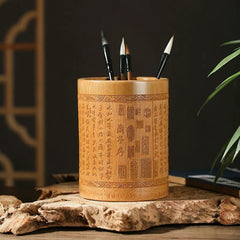
- On a desk — pens, pencils, a ruler, scissors. Weight matters here: at roughly 450 g the large size does not slide when you pull a pen out one-handed.
- In a bathroom — makeup brushes, standing upright the way they should be stored rather than lying in a bag. Bamboo and water are not friends, so keep it out of the shower and wipe the rim if it gets splashed.
- Beside a tea tray — the six tools of gongfu tea live in a cylinder exactly this shape. That is what the Chinese name on the original listing refers to.
- As a gift on its own — for a teacher, a calligrapher, someone who just passed an exam, or someone opening a business. The text does the work; you do not have to explain it.
What varies from piece to piece
Bamboo is a grass, and no two culms are the same. Diameter and roundness drift a few millimetres from the listed size. Colour ranges from pale straw to amber depending on how long the piece was heat-treated, and the two are not matched within an order. The base is the natural node of the culm, so it is convex rather than flat: the pot sits stable, but it does not sit flush, and on a glass desk you will see light under the edge. None of this is a defect. It is what separates a cut culm from a moulded one.
Care
Wipe with a dry cloth. Keep it out of standing water, the dishwasher and direct sun. Once a year, if the surface starts to look dry, rub in a drop of mineral oil or wood wax and buff it off. The finish is a hand-rubbed wax oil rather than a lacquer film, so it dulls slowly and can be brought back. Both brass-free bamboo and the carved cuts darken with handling, and the characters will pick up a little shadow in the grooves over time, which makes the text easier to read, not harder.
Frequently asked questions
Is this a pen holder or a makeup brush holder?
Both, and the listing means it literally. The small and deep-carved sizes are the two most people buy for makeup brushes, because a brush collection is usually 10 to 20 pieces and the small pot takes that comfortably. The large size is the pen-and-desk one. Nothing about the design changes between the two uses.
Will the bamboo crack?
Bamboo moves with humidity, so a hairline along the grain is possible in a very dry climate, especially the first winter. The pieces here are heat-treated before carving, which removes most of the moisture and the starch that cause a new piece to split in its first year. Keep it away from radiators and direct sun and you have removed almost all of the risk. A split through the wall is not normal and would be a defect.
Is the calligraphy carved or printed?
Carved, with a chisel, after the cylinder is finished. You can check it with a fingernail: a printed or laser-etched surface feels like a dip, a carved one has a shoulder you catch on. The deep-carved designs stand several millimetres proud of the background and cast a shadow under side light.
What does the Chinese text mean?
Each design is a real text or motif, and the descriptions above translate all seven. The short version: The Analects is Confucius, Preface to the Orchid Pavilion is the most famous piece of Chinese calligraphy, Thirty-Six Stratagems is a military strategy collection, Four Gentlemen is plum-orchid-bamboo-chrysanthemum, Smooth Sailing and Horse & Success are both wishes for good fortune in a new venture, and Qin Yuan Chun is the name of a poetry metre.
Which size should I get?
For a desk, the large. It is 16.5 cm tall and 12 cm across the rim, which holds a full set of pens or brushes without them leaning on each other. For makeup brushes, the small or the deep-carved. For a tea tray, the small. If it is a gift and you are unsure, the deep-carved sits between the two and photographs best.
Can it hold calligraphy brushes?
Yes, and that is what it was designed for. Chinese calligraphy brushes run 20 to 30 cm long, so they will stand with most of the handle above the rim. The large size is the one to pick if you have more than a few.
Is it heavy enough to stay put?
The large size weighs roughly 450 g, the deep-carved about 240 g, and the small about 170 g. All three are solid bamboo with a wall close to a centimetre thick at the base, so they do not tip when you pull something out one-handed. The small is the one that can be knocked over by a cat.
Is it ready to give as a gift?
It ships wrapped, not boxed. If you are buying it as a present, tell us in the order notes and we will include a card. The piece itself needs no explanation, but the text does, and the card covers it.
If you like this one
More from the same bench:
- Hand-carved solid bamboo corn ornament — the same hand-carved bamboo, at tea-pet scale.
- Woven bamboo gourd bottle charm — bamboo worked the other way, woven rather than carved.
Browse the full bamboo collection, or read what the six tools of gongfu tea actually do — this pot is the cylinder they live in.
Related Products
Example product title
- From $28.60
$35.70- From $28.60
- Unit price
- per
Example product title
- From $28.60
$35.70- From $28.60
- Unit price
- per
Example product title
- From $28.60
$35.70- From $28.60
- Unit price
- per
Example product title
- From $28.60
$35.70- From $28.60
- Unit price
- per
Example product title
- From $28.60
$35.70- From $28.60
- Unit price
- per
Example product title
- From $28.60
$35.70- From $28.60
- Unit price
- per
Example product title
- From $28.60
$35.70- From $28.60
- Unit price
- per
Example product title
- From $28.60
$35.70- From $28.60
- Unit price
- per
Example product title
- From $28.60
$35.70- From $28.60
- Unit price
- per
Example product title
- From $28.60
$35.70- From $28.60
- Unit price
- per
Recently Viewed Products
Example product title
- From $28.60
$35.70- From $28.60
- Unit price
- per
Example product title
- From $28.60
$35.70- From $28.60
- Unit price
- per
Example product title
- From $28.60
$35.70- From $28.60
- Unit price
- per
Example product title
- From $28.60
$35.70- From $28.60
- Unit price
- per
Example product title
- From $28.60
$35.70- From $28.60
- Unit price
- per
Example product title
- From $28.60
$35.70- From $28.60
- Unit price
- per
Example product title
- From $28.60
$35.70- From $28.60
- Unit price
- per
Example product title
- From $28.60
$35.70- From $28.60
- Unit price
- per
Example product title
- From $28.60
$35.70- From $28.60
- Unit price
- per
Example product title
- From $28.60
$35.70- From $28.60
- Unit price
- per
- Choosing a selection results in a full page refresh.
