






Tang Dynasty Lady Embroidered Sachet Charm, Double-Sided
This is a round hand-embroidered...
- $33.00
$41.50- $33.00
- Unit price
- per
Subtotal:
$33.00
Natural materials
No two pieces exactly alike
Free shipping over $59
30-day hassle-free returns


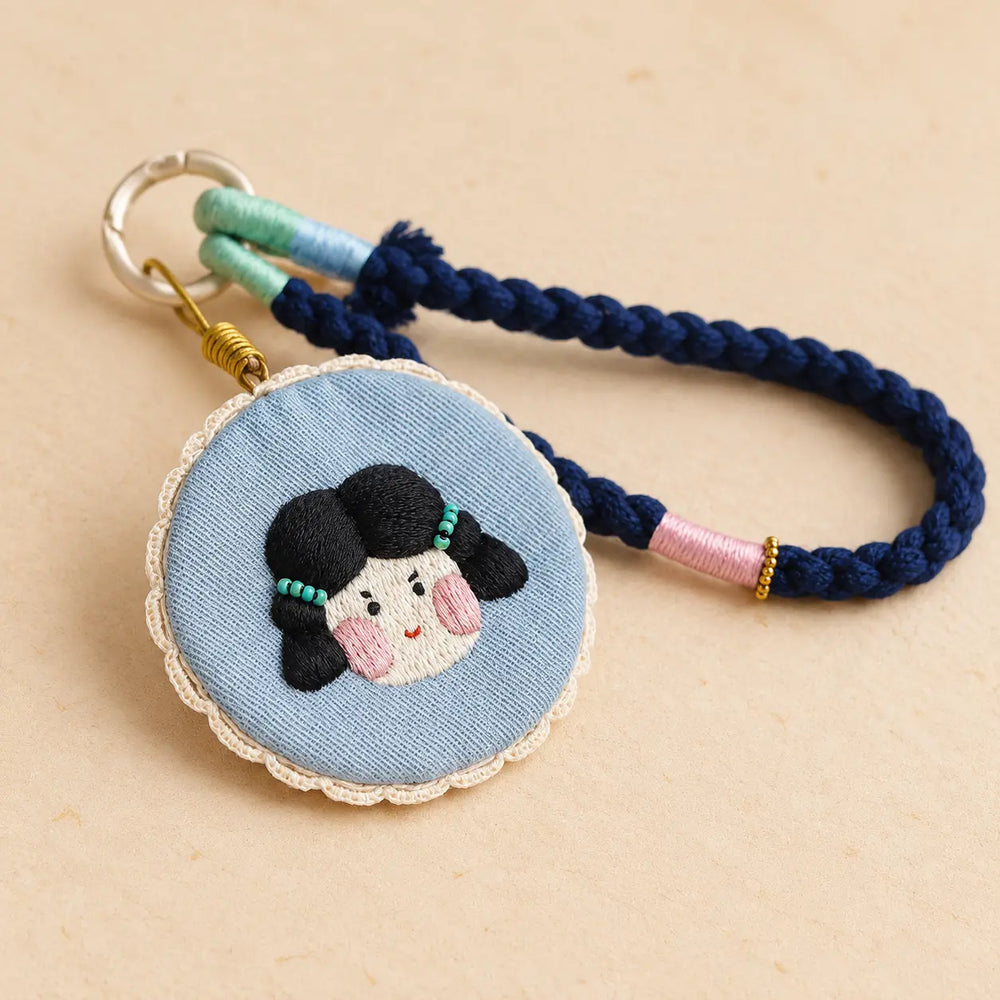
This is a round hand-embroidered sachet charm, 6 cm across including the scalloped lace edge, with a Tang dynasty court lady worked in long-staple cotton thread on one face and a four-character Chinese wish on the other. The body is a padded pouch rather than a flat disc. The braided cotton wrist strap unclips, which means the charm can hang on its own.
Most bag charms are blank on the back.
A charm is usually finished on one side and forgotten on the other. The back is plain felt, a raw seam, or nothing at all — because nobody is expected to look. This one is worked on both faces, front and back, in the same thread at the same density.
The body is a pouch, not a flat disc. Two layers of cotton are joined around the scalloped edge with padding between them, which is why it holds its shape instead of curling at the rim. That construction is old: small padded pouches were part of Tang-era dress, worn at the waist and turned over in the hand. The shape here is a modern reading of that habit rather than a copy of any one historical object.
Two faces, two different jobs
The front is the portrait. A court lady with a high black coiffure, small seed-bead pins at the temples, a pale face and a deliberate flush across both cheeks. The stitching is dense and slightly raised, so the black hair sits above the pale silk of the face and you can feel the step between them with a fingertip.
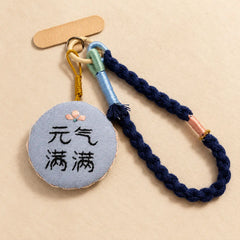
The back is text, embroidered in the same thread as the front — not printed, not appliquéd. In Cinnabar Red it reads 财圆滚滚: wealth rolling in, round and continuous, with 圆 doing double duty as the word for round and the shape of the charm itself. In Moon Blue it reads 元气满满: full of vitality. Turn it over and the object says something to whoever is standing next to you.
It comes apart into three pieces
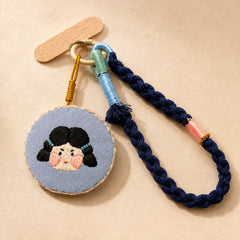
The braided wrist strap, the ring, and the charm are three separate parts that clip together. Leave it whole and it works as a phone strap or a bag handle wrap. Unclip the strap and the charm hangs from its own short gold cord. Take the charm off entirely and the strap still works on its own.
This matters more than it sounds. A charm that cannot be removed gets in the way every time you set a bag down. One that comes off gets used instead of tolerated.
Cinnabar Red and Moon Blue
Two colourways, each built around its own pair of words.
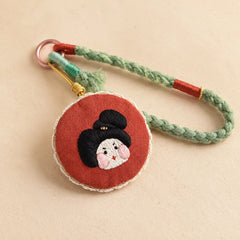
Cinnabar Red is a warm brick tone on cotton, edged in cream lace, hung on a sage-green braided cord with cinnabar and jade-green wraps. The back reads 财圆滚滚 — for the person who would rather be told things are going well.
Moon Blue is a pale grey-blue, same cream lace, on a navy cord with pink and pale-blue wraps. The back reads 元气满满 — for the person who would rather be told to keep going.
Both are the same size, the same construction and the same thread. The difference is the mood, and it is a real difference: the two read as different objects on a bag.
Size and materials
The charm is 6 cm across at its widest point, measured over the lace edge. Everything inside and out is cotton — the embroidery ground, the lining, and the thread — which is why it has no sheen and does not photograph like polyester.
| Measurement | Metric | Imperial |
|---|---|---|
| Charm diameter, over the lace edge | 6 cm | 2.4 in |
The embroidery thread is Royal Broderie long-staple Egyptian cotton, mercerised twice and gassed, which is the reason the stitches sit flat and catch light along the direction of the stitch rather than glaring. The braided cord is hand-braided cotton. The wraps on the cord are Taiwan jade cord, and the small beads at the joins are glass seed beads.
| Part | Material |
|---|---|
| Embroidery ground and lining | 100% cotton cloth, inside and out |
| Embroidery thread | Royal Broderie long-staple Egyptian cotton, double-mercerised, gassed |
| Wrist strap | Hand-braided cotton cord |
| Colour wraps on the cord | Taiwan jade cord |
| Beads at the joins | Imported glass seed beads |
| Hardware | Metal ring and clasp, gold-tone wrapped joins |
| Embroidery hoop (DIY kit only) | 10 cm bamboo hoop |
Because the body is padded and hand-finished, no two are identical. The lace edge wanders by a millimetre or two, the flush on the cheeks is never exactly the same size, and the embroidery density varies slightly with the stitch. That is what hand-work looks like up close, and it is the reason a photograph of one charm is not a promise about the next.
How it arrives
In a kraft paper box — natural brown board, no plastic window, no printing across the lid. The charm sits inside, and the braided strap is coiled separately so it does not press against the embroidery in transit. There is no plastic bag inside the box; the charm is wrapped in tissue.
If you are giving it away, the box is the packaging — it does not need a second layer, and it does not look like something that was repacked.
The finished piece, and the kit
Two ways to buy the same design. The finished piece arrives assembled and ready to clip on. The kit arrives as flat cotton with the design printed on it in faint blue guide lines, plus the thread, needles, cord, fittings and a video walkthrough — and a 10 cm bamboo hoop if you choose the version with one.
The printed guides are the whole trick. The circle, the concentric rings and the outline of the figure are already on the cloth, so the kit is about stitching rather than drawing. Most people finish in a few evenings.
Care
Spot clean only. Damp a cloth, wring it until it stops dripping, and press rather than rub — rubbing lifts the satin stitches and fuzzes the lace edge. Do not wash, do not soak, and do not iron directly on the embroidery; press the back through a cloth if it needs flattening. Keep it out of prolonged direct sun, which fades the cinnabar faster than the blue.
The lace edge is the part that ages first. It is cotton, cut in scallops, and the tips soften with handling — that is normal and it does not unravel, because the edge is bound rather than raw.
Where it goes
On a bag handle, where the strap wraps once and the charm hangs clear of the hardware. On a phone, clipped to the case loop rather than the camera ring. On a car mirror, where a small charm reads better than a large one. On a keyring, where 6 cm is small enough not to rattle against a pocket.
The strap is the part that makes it work in all four places, because it can be shortened by wrapping it twice.
If you want the same idea in a different material, the hand-carved bamboo sachet charm is the wood version, carved rather than stitched. If it is the embroidery itself you are after at a larger scale, the Year of the Horse charm uses the same technique on a bigger body. And if the strap is the part you actually want, the seed phone charm is built around one.
Everything in this family sits in the charm collection.
Frequently asked questions
Is the back embroidered, or is it plain?
Embroidered, in the same thread and at the same density as the front. In Cinnabar Red the back reads 财圆滚滚, four characters worked in a diagonal line with a small leaf motif. In Moon Blue it reads 元气满满. Neither is a lining cloth or a printed panel — turn the charm over and there is a second finished face.
How big is it, and will it fit on a phone?
The charm is 6 cm across at its widest point, measured over the lace edge. That is small enough for a phone case loop and large enough to read the embroidery at arm's length. The braided strap wraps twice around a bag handle or clips to a case loop.
Can I take the charm off the strap?
Yes, and that is the point of the design. The strap, the ring and the charm are three parts that clip together. Wear it whole as a phone or bag strap, hang the charm alone from its own short gold cord, or use the strap on its own as a wristlet.
Is the embroidery done by hand?
Yes. Each piece is stitched by hand in long-staple Egyptian cotton thread, then joined and finished by hand. Because of that, no two are identical — the lace edge varies by a millimetre or two, the cheek flush is never exactly the same size, and stitch density shifts slightly across the figure.
What is the difference between the finished piece and the DIY kit?
The finished piece arrives assembled and ready to use. The kit arrives as flat cotton with the design printed in faint blue guide lines, plus thread, needles, cord, fittings and a video walkthrough — and a 10 cm bamboo hoop on the versions that include one. You stitch it yourself and assemble it at the end.
Will the colour fade?
The cotton is dyed, not printed, and it holds colour well indoors. Prolonged direct sun is what fades it, and cinnabar goes before blue does. A bag that lives indoors and comes out on weekends will look the same in a year. One left on a car dashboard through a summer will not.
How do I clean it?
Spot clean only. Damp a cloth, wring it out until it stops dripping, and press rather than rub. Do not wash it, do not soak it, and do not iron directly on the embroidery — press the back through a cloth if it needs flattening. Keep it out of prolonged direct sun, which fades the cinnabar faster than the blue.
Will the lace edge fray?
No. The scalloped edge is bound rather than cut raw, so the tips soften with handling instead of unravelling. If a tip does work loose, trim it with sharp small scissors rather than pulling it — pulling tightens the scallop and distorts the circle.
Related Products
Example product title
- From $33.00
$41.50- From $33.00
- Unit price
- per
Example product title
- From $33.00
$41.50- From $33.00
- Unit price
- per
Example product title
- From $33.00
$41.50- From $33.00
- Unit price
- per
Example product title
- From $33.00
$41.50- From $33.00
- Unit price
- per
Example product title
- From $33.00
$41.50- From $33.00
- Unit price
- per
Example product title
- From $33.00
$41.50- From $33.00
- Unit price
- per
Example product title
- From $33.00
$41.50- From $33.00
- Unit price
- per
Example product title
- From $33.00
$41.50- From $33.00
- Unit price
- per
Example product title
- From $33.00
$41.50- From $33.00
- Unit price
- per
Example product title
- From $33.00
$41.50- From $33.00
- Unit price
- per
Recently Viewed Products
Example product title
- From $33.00
$41.50- From $33.00
- Unit price
- per
Example product title
- From $33.00
$41.50- From $33.00
- Unit price
- per
Example product title
- From $33.00
$41.50- From $33.00
- Unit price
- per
Example product title
- From $33.00
$41.50- From $33.00
- Unit price
- per
Example product title
- From $33.00
$41.50- From $33.00
- Unit price
- per
Example product title
- From $33.00
$41.50- From $33.00
- Unit price
- per
Example product title
- From $33.00
$41.50- From $33.00
- Unit price
- per
Example product title
- From $33.00
$41.50- From $33.00
- Unit price
- per
Example product title
- From $33.00
$41.50- From $33.00
- Unit price
- per
Example product title
- From $33.00
$41.50- From $33.00
- Unit price
- per
- Choosing a selection results in a full page refresh.
