






Bamboo Abacus Keychain, Hand-Carved Lucky Charm with Brass Beads
Bamboo Abacus Keychain A bamboo...
- $33.00
$41.50- $33.00
- Unit price
- per
Subtotal:
$33.00
Natural materials
No two pieces exactly alike
Free shipping over $59
30-day hassle-free returns


Bamboo Abacus Keychain
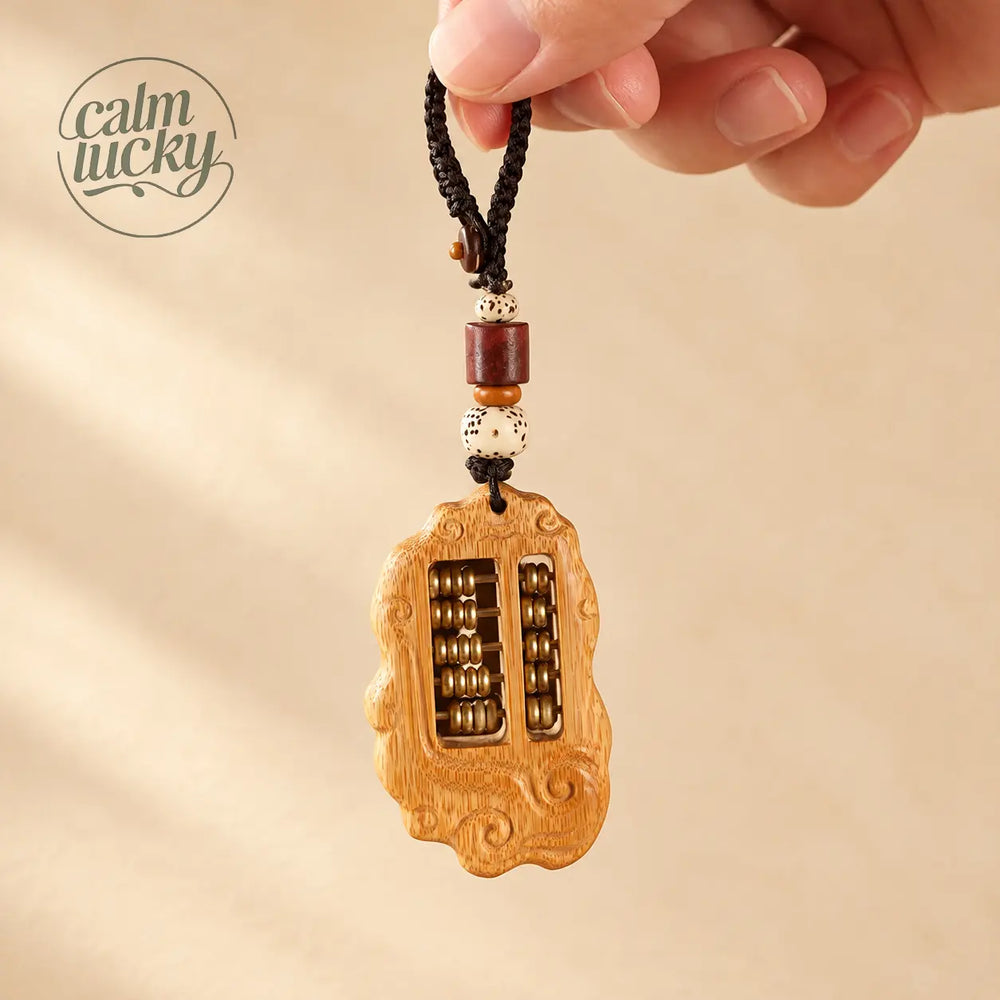
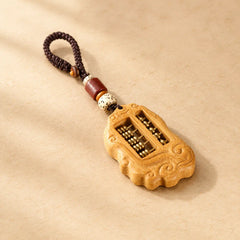
A bamboo abacus keychain is a small hand-carved charm built around a working miniature abacus — suanpan in Chinese, "counting frame" in older English, and simply abacus almost everywhere now. This one is cut from solid bamboo, framed in a ruyi cloud pattern, and set with two rows of five brass beads that actually slide. It measures 2 in (5 cm) long, 1.2 in (3 cm) wide and 0.3 in (8 mm) thick, and hangs from a hand-woven cord strung with bodhi seed and rosewood.
Why the bamboo has to be solid
Walk into any bamboo grove and you are looking at tubes. A culm is hollow by design — that is what makes bamboo the fastest-growing plant on earth, and it is also why most bamboo craft is woven, bent or split rather than carved. Cut a window through a hollow wall and the wall splits along the grain. There is no second attempt.
Solid bamboo is the exception. It grows slower, the culms are smaller, and the usable heartwood is a fraction of what goes in. What you get for the trouble is a material with the density of a hardwood and almost no grain direction — it can be carved across, drilled through, and cut into an open frame 8 mm thick without coming apart. Sanded through successive grits and polished, the surface closes up and takes a faint jade-like sheen. That sheen is where the Chinese name comes from: yu zhu, jade bamboo. It describes the finish, not a different plant.
Freshly cut bamboo is also wet, and wet bamboo moves. Pieces like this are cut from stock that has dried and settled first. Carve green bamboo into a thin frame and it will cup and crack within a season as it releases the rest of its moisture. That waiting time does not show up anywhere in the finished object. It is still the reason the object survives.
Six steps, and four of them can end the piece
There is no jig, no CNC, no batch. Every one goes through the same sequence by hand:
- Selecting — hollow culms are rejected outright. The blank has to come from a solid piece dense enough to survive being sliced into an 8 mm plate.
- Slicing — the plate is cut thin. Cut it uneven and the frame ends up thicker on one edge than the other, and there is no planing it back to level once the window is open.
- Carving the frame — the ruyi cloud edge is cut with a knife, not routed. A router leaves a rounded, machined edge that reads as plastic at this size. A knife cut goes one direction only: too deep and the frame is pierced, too shallow and the cloud casts no shadow.
- Opening the window — the slot that holds the bead rods is chiselled out of the solid centre. This is the step that fails. The remaining walls are a few millimetres thick on all four sides, and bamboo splits along its fibres the moment the pressure goes wrong.
- Sanding — several grits, in order, by hand. Skip one and the scratches from the previous grit stay visible under the polish; the surface looks oiled rather than finished.
- Stringing — the cord is braided and the beads threaded last, because the beads have to be positioned against the finished frame. Get the spacing wrong and the piece hangs crooked.
Four of those six steps can destroy the piece outright, and they happen after most of the work is already in it. That is the arithmetic behind a hand-carved object. The price is not paying for the minutes that went right; it is paying for the ones that did not.
What is actually in your hand
Four materials, none of them filler:
- Solid bamboo — the frame, the window, the whole body. Dense enough to be carved open, and sanded until the surface takes a jade-like sheen.
- Brass beads — two rows of five, on brass rods. Brass rather than zinc alloy because it is heavier per bead, which is what makes the slide feel like something rather than nothing, and because it dulls to a warmer gold instead of flaking. The sound is a dry click, not a rattle.
- Bodhi seed and rosewood — the beads above the frame, one pale and pitted, one dark and close-grained. Both are chosen for a property that has nothing to do with how they look on day one: they darken and polish with handling. A piece carried daily for a year will not look like the photograph.
- Hand-woven cord — braided, not glued. A glued cord fails at the joint within months; a braid fails nowhere, because there is no joint. The loop is sized to pass over a key ring or a bag clasp.
Why an abacus, of all things
The abacus is the one piece of Chinese material culture that never needed translating. It appears in written records before the Tang dynasty, was still in daily use in shops into the 1990s, and was added to UNESCO's intangible cultural heritage list in 2013 — not as an antique, but as a living practice. In merchant households it meant something narrower than "calculator". It meant knowing your numbers to the last bead. The idiom is xin zhong you shu — literally "there is a number in your heart", meaning to know exactly where you stand.
That is what this object is quoting. Not a mascot, not a souvenir replica. A working abacus, shrunk until it fits in a palm.
Size, precisely
2 in long, 1.2 in wide, 0.3 in thick. A little longer than a house key, about as thick as two stacked credit cards, and about an ounce in weight. Small enough to disappear in a pocket, large enough that the beads are genuinely playable with a thumb.
Where it hangs
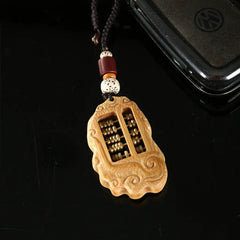
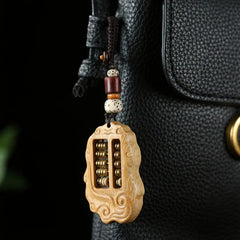
A key ring, where it does the obvious job and gives you something to do at a red light. A bag clasp, where the brass catches light against leather. A car's rear-view mirror, which is where most of these end up in China. Or a phone wrist strap, if you carry your phone that way.
Care
Bamboo dislikes standing water and direct sun. Wipe it with a dry cloth, keep it out of the dishwasher and the bath, and oil it once a year with a drop of mineral oil if the surface starts to look dry. Brass dulls to a softer gold over months; a rub with a dry cloth brings the shine back, and some people prefer the dull version. The bamboo will darken slightly as it takes on hand oil — that is the material ageing, not a flaw, and it is the reason the beads were chosen to do the same thing.
What varies from piece to piece
These are cut and carved one at a time, so no two are identical. The grain runs differently on every blank, which means the cloud edge carries a slightly different pattern of light each time. Colour ranges from pale straw to warm honey depending on how much sun the culm saw while it grew, and it deepens with handling. Bead spacing and cord length are set by hand, so a finished piece may sit a few millimetres off the length above. None of that is a defect. It is the difference between a carved object and a moulded one.
Frequently asked questions
Does the abacus actually work?
Yes. There are two rows of five brass beads threaded on brass rods, and every bead slides. It is not a working calculator — a real suanpan runs nine to thirteen rods, and two is not enough for arithmetic — but the beads move the way they should, and that is what your thumb is looking for.
Is it solid bamboo or a veneer?
Solid, all the way through. Most bamboo is a hollow tube; this is cut from a dense solid culm, which is also why it can be carved with an open window in the middle without splitting. The jade-like sheen is the finish, not a coating — the piece is sanded through several grits and polished, and the Chinese name for this material, yu zhu, refers to exactly that look.
What makes this different from a machine-made abacus charm?
Three things you can see at arm's length. The frame edge is knife-cut, so the ruyi cloud has a sharp shoulder rather than the rounded profile a router leaves. The body is solid bamboo, not hollow tube with a veneer. And the beads are brass on brass rods, which is heavier and sounds different from zinc alloy. Machine-made versions of this exist for a few dollars; the difference is not subtle in the hand.
Will the brass beads fall out?
They are captured on brass rods set into a chiselled channel, so they cannot slide off the ends. The failure mode to watch for is the bamboo drying and shrinking around the rods, which takes years of dry indoor air. Keeping it away from radiators and direct sun is the whole of the maintenance.
Can I hang it on a car mirror?
Yes, and that is one of its intended uses. The cord is braided rather than glued, and the loop is sized for a mirror stalk as well as a key ring. Keep in mind that anything hanging on a mirror swings, and the beads will click against the bamboo while you drive.
Is it too small to give as a real gift?
It is 2 in long, so it is a small object, and it reads as one. What makes it hold up as a gift is the density of the thing — carved frame, moving brass, bodhi seed, braided cord — rather than its size. It arrives ready to hang, not in a presentation box.
Is this a good gift for someone who works with numbers?
It is the most literal answer to that question you can buy. Accountants, bookkeepers and maths teachers tend to read the abacus immediately; everyone else reads it as a small carved charm with moving parts. It works on both levels, which is unusual.
What if the bamboo cracks?
Bamboo is a grass, and it moves with humidity. A hairline along the grain is possible in very dry climates and does not affect how the piece hangs or how the beads move. A split through the frame is not normal and would be a defect — send a photo and we will replace it.
If you like this one
More from the same bench:
- Hand-carved solid bamboo corn ornament — the same solid bamboo, carved as a tea pet rather than a keychain.
- Bodhi bead gourd charm — same bodhi seed and rosewood, same car-mirror and bag-clasp job.
Browse the full bamboo collection, or read what bamboo has meant in Chinese homes — the abacus and the bamboo come out of the same set of ideas.
Related Products
Example product title
- $33.00
$41.50- $33.00
- Unit price
- per
Example product title
- $33.00
$41.50- $33.00
- Unit price
- per
Example product title
- $33.00
$41.50- $33.00
- Unit price
- per
Example product title
- $33.00
$41.50- $33.00
- Unit price
- per
Example product title
- $33.00
$41.50- $33.00
- Unit price
- per
Example product title
- $33.00
$41.50- $33.00
- Unit price
- per
Example product title
- $33.00
$41.50- $33.00
- Unit price
- per
Example product title
- $33.00
$41.50- $33.00
- Unit price
- per
Example product title
- $33.00
$41.50- $33.00
- Unit price
- per
Example product title
- $33.00
$41.50- $33.00
- Unit price
- per
Recently Viewed Products
Example product title
- $33.00
$41.50- $33.00
- Unit price
- per
Example product title
- $33.00
$41.50- $33.00
- Unit price
- per
Example product title
- $33.00
$41.50- $33.00
- Unit price
- per
Example product title
- $33.00
$41.50- $33.00
- Unit price
- per
Example product title
- $33.00
$41.50- $33.00
- Unit price
- per
Example product title
- $33.00
$41.50- $33.00
- Unit price
- per
Example product title
- $33.00
$41.50- $33.00
- Unit price
- per
Example product title
- $33.00
$41.50- $33.00
- Unit price
- per
Example product title
- $33.00
$41.50- $33.00
- Unit price
- per
Example product title
- $33.00
$41.50- $33.00
- Unit price
- per
- Choosing a selection results in a full page refresh.
