







Hand-Embroidered Wu Lou Gourd Amulet, Five Poisons
This is a hand-embroidered cloth...
- $88.00
$108.00- $88.00
- Unit price
- per
Subtotal:
$88.00
Natural materials
No two pieces exactly alike
Free shipping over $59
30-day hassle-free returns


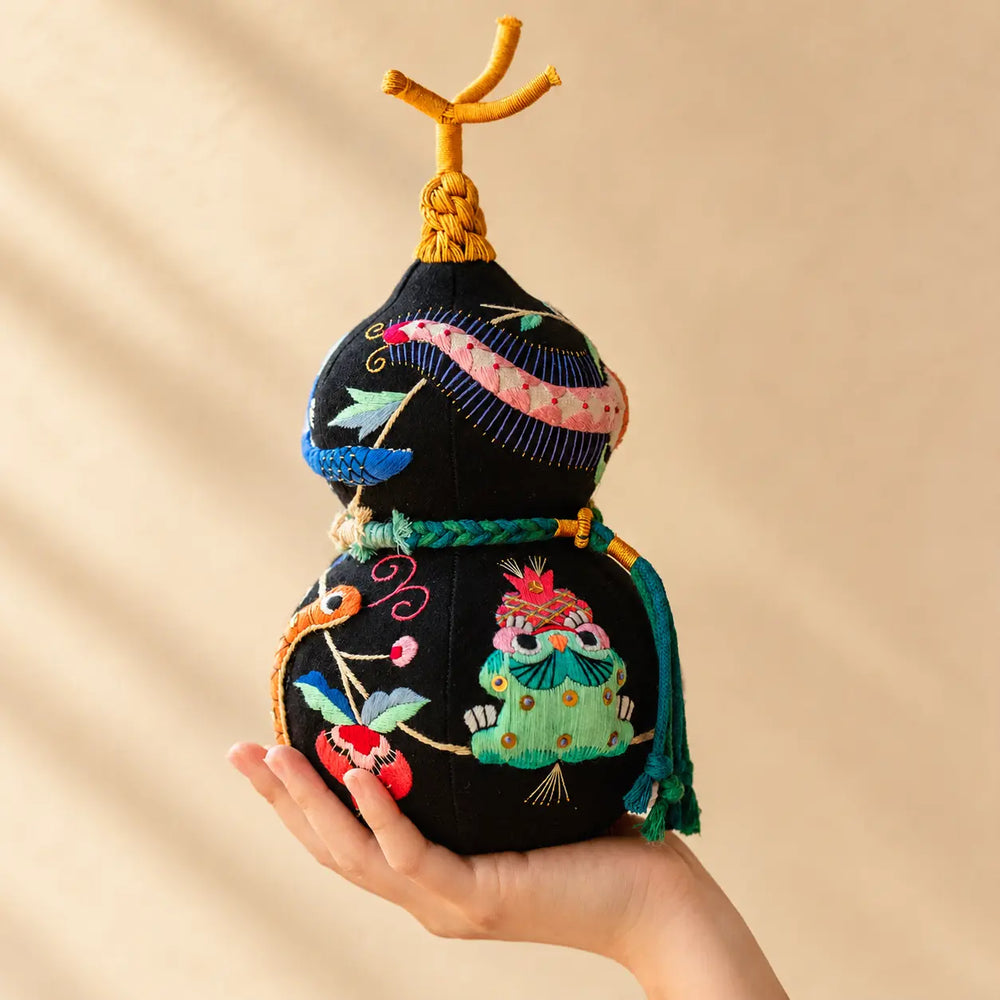
This is a hand-embroidered cloth gourd in the wu lou shape, worked in five traditional stitches on a black cotton ground and filled with cotton rather than left flat. It comes in two sizes: a large gourd 30 cm tall and 15 cm wide, built to be worn crossbody or stood on a shelf, and a small gourd 8.5 cm tall and 5 cm wide, light enough to hang at the neck or from a bag. The braided cord unclips on both, so the gourd can be worn, hung, or set down on its own.
Five poisons, stitched instead of feared
The five creatures on this gourd are the ones a Chinese household was once told to watch for in early summer: snake, scorpion, centipede, toad and gecko. They are the wu du, the five poisons, and the fifth day of the fifth lunar month — the Dragon Boat Festival — was the day they were said to come out.
The old response was not to avoid them but to wear them. Embroidered on cloth and carried on the body, the five were turned from a threat into a guard: 以毒攻毒, fight poison with poison. A child wearing a five-poison bib, a pillow stitched with five-poison medallions, a gourd hung at the waist — the logic was the same. If the dangerous things were already on you, and on your side, nothing worse could reach you.
The motif is documented well beyond folk memory. A five-poison patterned ear pillow is held by the Shanxi Provincial Arts and Crafts Museum; a Liao dynasty jade pendant set in animal forms is held by the Inner Mongolia Institute of Cultural Relics and Archaeology; a Qing dynasty cloisonné gourd vase with the ten-thousand-generations pattern is in the Liaoning Provincial Museum. The gourd and the five poisons have been paired in Chinese material culture for centuries, across jade, enamel, textile and paper.
Why a gourd and not a disc
The gourd carries its own layer. 葫芦, hu lu, sounds close to 福禄, fu lu — blessing and official salary — which is why it turns up on everything from wine vessels to door hangings. The narrow waist and the double belly are read as 多子, many children, because a gourd holds many seeds.
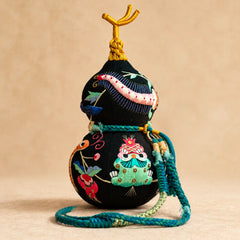
Shape matters here for a practical reason too. A gourd has a waist, and a waist is a place to bind. The green braided cord that cinches this one is not decoration — it is what gives the silhouette its pinch, and it is tied by hand on every piece.
The top is the part collectors look at first. On a real wu lou the 龙头, the dragon head, is the dried stem, and a broken one halves the value. Here it is rebuilt in gold cord, twisted into a two-horned head and trimmed by hand with small scissors. It will not snap off in a bag.
The large one is a bag. The small one is a charm.
These are not the same object at two scales, and the difference is worth understanding before you choose.
The large gourd is 30 cm tall. That is big enough to wear across the body on its 90 cm cord, which is how it is shown in most of the photographs — a soft sculptural bag against dark clothing. It also stands. Put it on a shelf or a wooden base and it reads as an object rather than an accessory, because the padded body holds its shape and the bound waist keeps the silhouette upright.
One thing worth being clear about before you choose: this is not a working bag. The body is packed with cotton wadding to hold the gourd silhouette, so there is no cavity inside — it is worn as an accessory and stood as an object, not carried as a container. If you want something that holds a phone and a card, this is not that bag.
The small gourd is 8.5 cm tall and 5 cm wide, on a 52 cm cord that adjusts by sliding the knot. It hangs at the neck, clips to a bag, or loops over a rear-view mirror. Inside the small one there are three jade-green beads, loose, so the gourd rattles faintly when it moves — 响籽, the sound seed. The large gourd does not have them; the beads only work at the small scale.
Both are stitched to the same standard. The small one is not a simplified version — it carries the same five creatures at a smaller scale, which is harder, not easier.
Five stitches, three passes, and a four-star rating
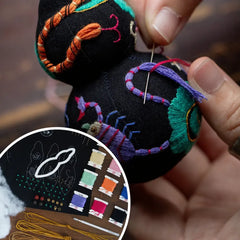
The embroidery uses five traditional stitches across three passes: the body of each creature first, then the outlines and detail, then the gold accents and the sequins that catch light when the gourd moves. The supplier rates the kit four stars out of five on difficulty, and that is honest — this is not an evening's work.
What makes it slow is the layering. The creatures are not flat patches of colour; each one is built up in overlapping stitches so the toad sits above the cloth and the snake's coils read as coils. The flowers and leaves between them are worked in the same density, which is why the black ground never looks empty.
The black is deliberate. Black cotton makes the pinks, greens, oranges and blues read hotter than they would on white, and it is the traditional ground for this motif — the same black used on the museum pieces the pattern comes from.
Size and materials
Every number below is measured, not estimated. The supplier's spec sheets carry all of it, which is unusual — most listings in this category leave the buyer to guess.
| Measurement | Large gourd | Small gourd |
|---|---|---|
| Height, top of the gold stem to base | 30 cm / 11.8 in | 8.5 cm / 3.3 in |
| Width at the lower belly | 15 cm / 5.9 in | 5 cm / 2.0 in |
| Braided cord, end to end | 90 cm / 35.4 in | 52 cm / 20.5 in |
| Embroidery hoop in the kit | 20 cm bamboo | 15 cm bamboo |
| Pre-printed cloth in the kit, largest piece | 36 × 38 cm | 20 × 20 cm |
The cord adjusts on both sizes. Slide the knot and the drop shortens; the large gourd goes from crossbody to shoulder, the small one from neck length to chest length. Neither cord is glued in place, so the gourd detaches and the cord can be used on its own.
| Part | Material |
|---|---|
| Ground cloth | Black cotton, printed with the guide outline before stitching |
| Embroidery thread | Professional-grade cotton floss, multi-colour, plus gold metallic thread |
| Filling | Cotton wadding, packed by hand |
| Waist binding and cord | Hand-braided cotton rope with gold thread running through |
| Dragon head at the top | Gold cord, twisted and trimmed by hand |
| Beads | Red agate and green jade, with metal spacers |
| Sound seeds, small gourd only | Three jade-green beads, loose inside the body |
| Hardware | Metal clasp and spring ring on the cord |
How it arrives
It ships in a kraft paper box. The gourd is nested inside with the cord coiled separately and the padded body packed so the gold stem does not press against anything in transit. The box is plain and rigid — no sleeve, no plastic window, nothing to unwrap twice.
The finished gourd and the kit ship in the same kraft box. What differs is inside: one arrives assembled, stitched and bound; the other arrives flat, with the printed cloth, the floss, the hoop and the instruction booklet.
If you are sending it straight to someone else, the kraft box holds up in a mailer. The body is padded, so the gourd keeps its shape and the cord does not tangle on the way.
The finished piece, and the kit
The finished gourd arrives stitched, filled, bound and assembled. You unclip the cord, decide where it goes, and you are done. Nothing to make.
The kit arrives as flat black cotton with the outline printed on it in guide lines, plus multi-colour cotton floss, gold thread, cotton wadding, jade and agate beads, metal findings, a hand-stitching needle, a heat-erasable pen, and a bamboo hoop. The instruction booklet is a fold-out with step diagrams and a QR code that opens the video walkthrough.
Five things the kit does not include, and the supplier says so plainly: an iron, tweezers, pliers, a ruler and scissors. You will want all of them.
The printed guide is what makes this beginner-possible. The circle, the five creatures and the flower fillers are already on the cloth, so you are stitching over a map rather than drawing one. The heat-erasable pen is for marking the parts the print does not cover.
Care
Do not wash it. The body is cotton stuffed with cotton wadding, and water will mat the filling into a lump that never comes back. Spot clean with a barely damp cloth, press rather than rub, and let it air dry flat away from heat.
Keep it out of direct sun for long stretches. The black ground is dyed, and while it holds colour well indoors, a summer on a car dashboard will fade it to charcoal and take the gold thread down with it.
The gold stem is the fragile part, not the embroidery. It is cord, not wire, so it bends before it breaks — but it will bend. Store the gourd upright or lying on its side, never hanging by the stem for months at a time.
If the cord needs cleaning, take it off first. It is cotton and it can be hand-washed cold and dried flat; the gourd cannot.
Where it goes
The large gourd works in three places: across the body on its long cord, standing on a shelf where the silhouette reads from across a room, and on a wall hook where the bound waist and the gold stem are at eye level. It is soft, so it packs flat — this is the rare object of this size that travels flat in a suitcase.
The small gourd works where an 8.5 cm object belongs: at the neck, on a bag, on a rear-view mirror, on a keyring. The rattle is the point at that scale — it is the only one of the two that makes a sound.
If you want the same protective motif in a different material, the hand-carved bamboo sachet charm is the carved version. If it is figurative embroidery you are after, the Tang dynasty lady sachet charm is the same technique at 6 cm. And if you want a charm built around a cord rather than a body, the Year of the Horse charm is the other end of that idea.
Everything in this family sits in the charm collection.
How tall is it, exactly?
The large gourd is 30 cm tall and 15 cm across at the lower belly, on a 90 cm cord. The small gourd is 8.5 cm tall and 5 cm wide, on a 52 cm cord. Both measurements are top of the gold stem to base, taken flat, not hanging. The cord on either size adjusts by sliding the knot.
Which size should I get?
Get the large one if you want something to wear across the body or stand on a shelf. At 30 cm it reads as an object from across a room, and it is the one shown worn crossbody in the photographs. Get the small one if you want a charm — at the neck, on a bag, on a mirror. The small one also rattles; the large one does not.
Is this a finished piece or a kit?
Both are sold, as separate variants. The finished piece arrives stitched, filled, bound and assembled. The kit arrives as flat printed cotton with the thread, wadding, beads, hardware, needle and hoop. Check the variant name before adding to cart — it says which one you are buying.
What is actually in the kit?
Black cotton printed with the guide outline, multi-colour cotton floss, gold metallic thread, cotton wadding, jade and agate beads, metal findings including a clasp and spring ring, a hand-stitching needle, a heat-erasable pen, a bamboo hoop (20 cm for the large, 15 cm for the small), and a fold-out instruction booklet with step diagrams and a QR code for the video walkthrough.
What do I need to buy separately for the kit?
An iron, tweezers, pliers, a ruler and scissors. The iron presses the cloth flat before you start, the tweezers pack wadding into the narrow waist, and the pliers are for the metal findings. None of these are in the box, and the supplier states this on the kit itself.
How is it packed?
It ships in a kraft paper box — the gourd nested inside with the cord coiled separately and the body padded so the gold stem does not press against anything in transit. The finished piece and the kit use the same box; what differs is what is inside it. No plastic window, nothing to unwrap twice.
How long does the kit take?
Longer than an evening. The supplier rates it four out of five on difficulty, and the reason is layering — five stitches across three passes, with each creature built up in overlapping stitches rather than filled flat. Most people spread it over several sittings. The printed outline saves you the drawing, not the stitching.
What are the five poisons?
Snake, scorpion, centipede, toad and gecko. In Chinese folk practice they were the creatures said to appear around the Dragon Boat Festival, the fifth day of the fifth lunar month, and the response was to wear them rather than avoid them — 以毒攻毒, fight poison with poison. Embroidered on cloth and carried on the body, they were turned from a threat into a guard.
Why does the small one rattle?
It has three jade-green beads loose inside the body — 响籽, the sound seed. The rattle only works at the small scale; the large gourd is packed solid with wadding and makes no sound. It is the clearest physical difference between the two sizes.
Will the black fade?
Not indoors. The ground is dyed cotton and it holds colour well away from sun. A summer on a car dashboard will take it to charcoal and dull the gold thread with it, so keep it out of long direct exposure.
How do I clean it?
Do not wash it. The body is cotton stuffed with cotton wadding, and water mats the filling into a lump that does not come back. Spot clean with a barely damp cloth, press rather than rub, and air dry flat away from heat. The cord is different — take it off and hand-wash it cold, then dry flat.
Can I carry things in the large one?
No. It is a sculptural bag, not a container — the body is packed with cotton wadding to hold the gourd silhouette, so there is no cavity to put anything in. It is worn as an accessory and stood as an object. If you want something that holds a phone and a card, this is not that bag.
Related Products
Example product title
- From $48.80
$61.80- From $48.80
- Unit price
- per
Example product title
- From $48.80
$61.80- From $48.80
- Unit price
- per
Example product title
- From $48.80
$61.80- From $48.80
- Unit price
- per
Example product title
- From $48.80
$61.80- From $48.80
- Unit price
- per
Example product title
- From $48.80
$61.80- From $48.80
- Unit price
- per
Example product title
- From $48.80
$61.80- From $48.80
- Unit price
- per
Example product title
- From $48.80
$61.80- From $48.80
- Unit price
- per
Example product title
- From $48.80
$61.80- From $48.80
- Unit price
- per
Example product title
- From $48.80
$61.80- From $48.80
- Unit price
- per
Example product title
- From $48.80
$61.80- From $48.80
- Unit price
- per
Recently Viewed Products
Example product title
- From $48.80
$61.80- From $48.80
- Unit price
- per
Example product title
- From $48.80
$61.80- From $48.80
- Unit price
- per
Example product title
- From $48.80
$61.80- From $48.80
- Unit price
- per
Example product title
- From $48.80
$61.80- From $48.80
- Unit price
- per
Example product title
- From $48.80
$61.80- From $48.80
- Unit price
- per
Example product title
- From $48.80
$61.80- From $48.80
- Unit price
- per
Example product title
- From $48.80
$61.80- From $48.80
- Unit price
- per
Example product title
- From $48.80
$61.80- From $48.80
- Unit price
- per
Example product title
- From $48.80
$61.80- From $48.80
- Unit price
- per
Example product title
- From $48.80
$61.80- From $48.80
- Unit price
- per
- Choosing a selection results in a full page refresh.
