




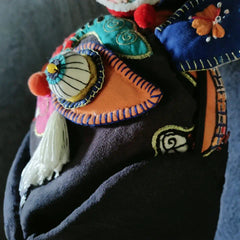


Chinese Tiger Head Hat DIY Embroidery Kit, Earflap Bonnet
A Chinese tiger head hat...
- $71.80
$89.80- $71.80
- Unit price
- per
Subtotal:
$71.80
Natural materials
No two pieces exactly alike
Free shipping over $59
30-day hassle-free returns


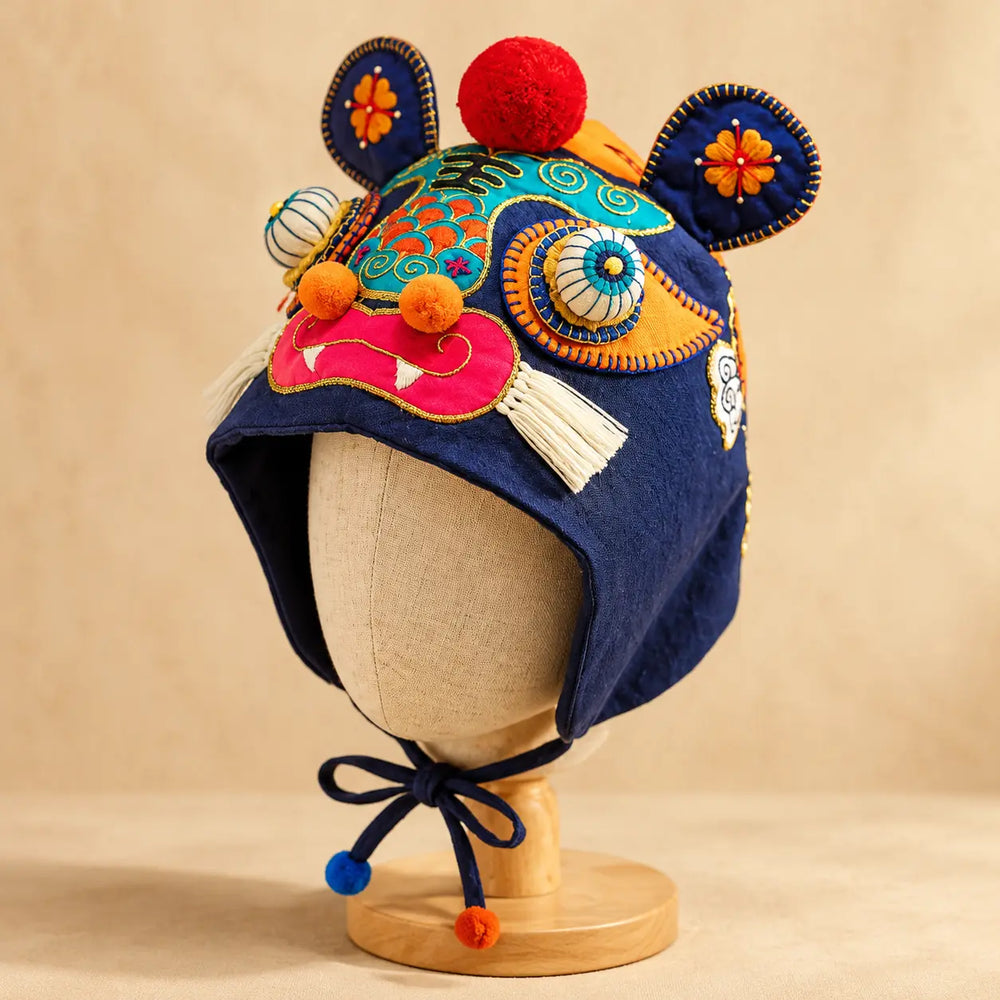
A Chinese tiger head hat is a folk bonnet stitched to look like a tiger's face — padded ears, embroidered whiskers, a pom-pom crown and a small tail at the back. This one is a DIY embroidery kit: you stitch the face yourself on pre-printed cotton, then close it and stuff it. It comes in an adult size for a 52–56 cm head and a kids size for 48–52 cm, or finished and ready to wear.
Why a tiger and not a lion
The tiger is the older guardian. In Chinese folk belief it is the animal that keeps children safe — a tiger on a child's hat is a warning to whatever is listening, not a decoration. That is why the hat is loud: the eyes are built up in layers, the brows are embroidered in a fish-scale pattern, and the forehead carries the 王 character that marks the tiger as king.
The tail is the part people do not expect. It sits at the back of the crown, padded and striped, with a fringe tip, and it moves when the wearer turns their head. In the folk version the tail is meant to look like it is still swishing — a tiger that is awake, not a tiger on a print.
None of this is costume. These hats were everyday winter wear across northern China for centuries, made by the women of the house from whatever cloth was left over, and given to a first grandchild. The version here keeps the construction and the colours and drops the part where you have to invent the pattern yourself.
Two sizes, and how to choose
Every figure below comes from the supplier's spec sheet or from measuring the sample. Nothing here is estimated.
| Measurement | Metric | Imperial |
|---|---|---|
| Adult hat, head circumference | 52–56 cm | 20.5–22 in |
| Kids hat, head circumference | 48–52 cm | 18.9–20.5 in |
| Kids hat, age guide | 8–12 years | — |
| Embroidery hoop in the kit | 20 cm | 7.9 in |
| Gift box (finished hats) | 24.5 × 24.5 × 15.8 cm | 9.6 × 9.6 × 6.2 in |
Measure around the widest part of the head, just above the ears, and let the tape sit flat. If the number lands on 52 cm you can wear either size — the chin ties take up the slack, and the kids size sits closer to the head. If it lands on 56 cm, take the adult.
The two sizes use the same pattern. Only the crown and the earflap depth change, which is why the kids version still carries the full tiger face rather than a simplified one.
Materials and construction
| Part | Material |
|---|---|
| Hat body and lining | Cotton canvas, pre-printed with the guide outline |
| Embroidery thread | Cotton floss, multi-colour |
| Eyes | Layered appliqué with padded centres, outlined in satin stitch |
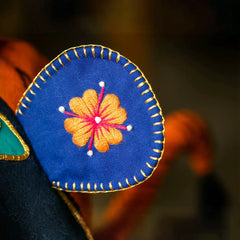
| Ears | Padded cotton with an appliqué five-petal flower |
| Crown pom-pom | Synthetic wool pom-pom, deep red |
| Whiskers | White cotton fringe, hand-knotted |
| Chin ties | Cotton tape |
| Tail | Padded cotton, striped, with a fringe tip |
| Filling | PP cotton |
| Hoop (kit only) | Bamboo, 20 cm |
The face is built in layers rather than stitched flat. The eye is a padded disc set inside two rings of appliqué, so it stands proud of the cheek instead of sitting level with it — that is what gives the hat its expression at a distance. The brow is a separate appliqué piece in fish-scale pattern, outlined in gold thread.
The body is cotton canvas, printed with the guide lines before it ships. The thread is cotton floss rather than silk, which matters for a hat that will be worn: cotton takes handling and does not snag the way silk does. The filling is PP cotton, so the hat keeps its shape if it gets damp.
What is in the DIY kit
The kit arrives flat. Inside the box:
- Pre-printed cotton canvas pieces, with the face, the brows, the ears and the tail already printed in guide lines
- Cotton floss in every colour the design needs
- Hand-stitching needles and a needle threader
- A water-erasable pen for marking the seam line
- Pom-poms in three sizes for the crown, the nose and the tie ends
- Black elastic and cotton tape for the chin ties
- PP cotton filling
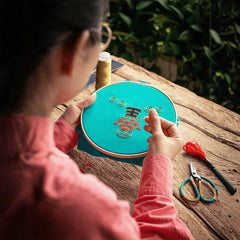
- A 20 cm bamboo embroidery hoop
- A printed pattern sheet with the hat outline, plus step diagrams and a QR code that opens the video walkthrough
The printed guide is what makes the kit possible for someone who has never embroidered. The face, the brow pattern, the ear flowers and the tail stripes are already on the cloth, so you are stitching over a map rather than drawing one. There is no transfer step and no tracing paper.
Four stitches, one bonnet
The kit uses four stitches and no others: backstitch for the outlines, blanket stitch for the appliqué edges, slip stitch to close the body after stuffing, and running stitch for the filler areas. The supplier rates it intermediate, and that rating is honest — the stitches are simple, but there are more of them than on a small charm.
Backstitch carries most of the work. Every outline on the face — the brow, the eye rings, the mouth, the 王 character — is backstitched, and a clean line depends on keeping the stitch length even. If you have done any hand sewing before, this is the part you already know.
Blanket stitch is the one people have to learn. It wraps the raw edge of each appliqué piece, and because the edge is curved, the spacing has to be judged by eye rather than counted. The instruction booklet shows it at three magnifications for exactly this reason.
How long it takes, and how hard it is
A first hat takes most people three to four evenings. The embroidery is about two thirds of that; the rest goes into the appliqué layers and the stuffing. The kit is rated intermediate rather than beginner because of the volume, not the difficulty of any single stitch.
If you have never held a needle, this is still a reasonable first project — but budget a week and expect the first ear to look different from the second. If you have embroidered before, the only new thing is the appliqué.
Where it is worn
It is a winter hat, and it is worn as one. The earflaps cover the ears, the chin ties hold it on in wind, and the body is stuffed enough to sit away from the head rather than flat against it. Beyond that:
- Lunar New Year — the obvious one, and the reason most people buy it. The tiger is a new-year animal, and the hat photographs well against red.
- Winter portraits — the hat reads at a distance, which is what you want in a photo where the face is small in the frame.
- A first birthday — the kids size starts at 48 cm, which fits most one-year-olds loosely and most eight-year-olds snugly.
- Fancy dress and stage — the tail and the pom-poms do the work that a costume-shop hat usually fakes.
It is not a sun hat and it is not waterproof. Cotton canvas and PP cotton will take cold and take wind, but a long rain will soak through, and the appliqué edges do not enjoy being dried on a radiator.
How it arrives
The DIY kit ships in a kraft paper box — natural brown board, no plastic window, no printing across the lid. The printed cloth, the floss, the pom-poms and the hoop sit inside with the smaller pieces in a paper bag so nothing rattles loose in transit.
The finished hats ship in a rigid gift box, 24.5 by 24.5 by 15.8 cm, with a jade-green lid over a blue gradient body. The hat sits on a printed card insert, so it arrives as a gift without you wrapping anything. There is no second layer to add.
If you are sending the kit straight to someone else, the kraft box holds up inside a mailer. If you are sending a finished hat, the gift box is the outer box — put it in a mailer and it arrives as it left.
Both ship within 10 days of the order. The kit is the quicker of the two to pick, pack and post. A finished hat is stitched to the size you chose, and that is where most of the ten days goes — so if you need it for a date, the kit is the safer order.
Care
Do not machine wash it. The body is stuffed with PP cotton and the face is built from layered appliqué; a wash cycle will mat the filling and lift the appliqué edges. Spot clean with a barely damp cloth, press rather than rub, and let it air dry flat away from heat.
The fringe whiskers will shed a few strands at first. That is normal for knotted cotton fringe and it settles. If a strand works loose, trim it level with the rest rather than pulling it out — pulling takes the knot with it.
Store it flat rather than hanging. A hat hung by one earflap for a season will dry out of shape at that ear, and the appliqué edge is the hardest part to press back.
More in this family
If you want the same hand-embroidery at a smaller scale, the sheep embroidery kit makes a 6 cm lamb charm in the same cotton floss, with two stitches instead of four — a gentler first project. The Tang dynasty lady sachet charm is the same idea worn rather than stitched: double-sided hand embroidery at 6 cm, with a four-character wish on the reverse. And the Wu Lou gourd amulet carries the five poisons in five traditional stitches, which is the closest thing on the site to the tiger in intent.
Everything in this family sits in the full collection. If you want the background on why these motifs survived, start with natural home craft.
Frequently Asked Questions
How big is the hat?
The adult hat fits a head circumference of 52–56 cm (20.5–22 in). The kids hat fits 48–52 cm (18.9–20.5 in), which is roughly ages 8 to 12. Measure around the widest part of the head, just above the ears, and let the tape sit flat. The chin ties take up the slack if you land between sizes.
Should I choose the adult or the kids size?
By head circumference, not by age. If the measurement is 52 cm or under, the kids size sits closer to the head and looks better; if it is 53 cm or over, take the adult. Both sizes use the same tiger face — the kids version is not simplified.
Is this a kit or a finished hat?
Both are available. The DIY Kit with Hoop is a flat-packed embroidery kit you stitch and stuff yourself, and it includes a 20 cm bamboo hoop. The Adult Finished Hat and Kids Finished Hat arrive made, in a rigid gift box. If you want to give a hat this week, take a finished one; if you want the evening, take the kit.
What exactly is in the DIY kit?
Pre-printed cotton canvas pieces, cotton floss in every colour the design needs, hand-stitching needles and a threader, a water-erasable pen, pom-poms in three sizes, black elastic and cotton tape for the chin ties, PP cotton filling, a 20 cm bamboo hoop, and a printed pattern sheet with step diagrams and a QR code for the video walkthrough.
What do I need to buy separately?
Scissors, and a thimble if you use one. Everything else is in the box. You do not need an iron, a light box or a transfer pen — the guide lines are printed on the cloth before it ships, so there is nothing to trace.
How long does one hat take to make?
Three to four evenings for a first-timer. The embroidery is about two thirds of the time; the rest goes into the appliqué layers, the stuffing and closing the body. Someone who already embroiders can usually finish it in two.
How hard is it? I have never embroidered.
It is rated intermediate, and the rating is about volume rather than difficulty. The four stitches — backstitch, blanket stitch, slip stitch, running stitch — are all basic. If you have never held a needle, budget a week and expect the first ear to look different from the second. If you have sewn anything by hand before, the only new skill is the appliqué.
What does a tiger head hat mean?
It is a guardian, not a decoration. In Chinese folk belief the tiger keeps children safe, so a tiger on a child's hat is a warning to whatever is listening. The 王 character on the forehead marks the tiger as king; the fish-scale brow and the layered eyes are there to make the face read as awake. The tail at the back is meant to look like it is still swishing.
Is it warm enough for winter?
For cold and wind, yes. The body is cotton canvas stuffed with PP cotton, the earflaps cover the ears, and the chin ties hold it on. It is not waterproof — a long rain will soak through — and it is not a substitute for a hat with a wool lining in deep winter.
How is it packed, and when does it ship?
The DIY kit ships in a kraft paper box, natural brown board, with the smaller pieces in a paper bag inside. The finished hats ship in a rigid gift box, 24.5 by 24.5 by 15.8 cm, jade-green lid over a blue gradient body, with the hat on a printed card insert. Both ship within 10 days of the order — the kit is picked and posted faster than a finished hat, which is stitched to your size first.
How do I clean it?
Do not machine wash it. Spot clean with a barely damp cloth, press rather than rub, and air dry flat away from heat. A wash cycle mats the PP cotton filling and lifts the appliqué edges. Store it flat rather than hanging by one earflap.
Can adults wear it, or is it only for children?
Adults can, and the adult size exists for that. The hat started as children's wear, but the adult version is cut for a 52–56 cm head and is bought about as often for winter portraits and New Year as for children.
Related Products
Example product title
- From $71.80
$89.80- From $71.80
- Unit price
- per
Example product title
- From $71.80
$89.80- From $71.80
- Unit price
- per
Example product title
- From $71.80
$89.80- From $71.80
- Unit price
- per
Example product title
- From $71.80
$89.80- From $71.80
- Unit price
- per
Example product title
- From $71.80
$89.80- From $71.80
- Unit price
- per
Example product title
- From $71.80
$89.80- From $71.80
- Unit price
- per
Example product title
- From $71.80
$89.80- From $71.80
- Unit price
- per
Example product title
- From $71.80
$89.80- From $71.80
- Unit price
- per
Example product title
- From $71.80
$89.80- From $71.80
- Unit price
- per
Example product title
- From $71.80
$89.80- From $71.80
- Unit price
- per
Recently Viewed Products
Example product title
- From $71.80
$89.80- From $71.80
- Unit price
- per
Example product title
- From $71.80
$89.80- From $71.80
- Unit price
- per
Example product title
- From $71.80
$89.80- From $71.80
- Unit price
- per
Example product title
- From $71.80
$89.80- From $71.80
- Unit price
- per
Example product title
- From $71.80
$89.80- From $71.80
- Unit price
- per
Example product title
- From $71.80
$89.80- From $71.80
- Unit price
- per
Example product title
- From $71.80
$89.80- From $71.80
- Unit price
- per
Example product title
- From $71.80
$89.80- From $71.80
- Unit price
- per
Example product title
- From $71.80
$89.80- From $71.80
- Unit price
- per
Example product title
- From $71.80
$89.80- From $71.80
- Unit price
- per
- Choosing a selection results in a full page refresh.
